Character of the day is rú. If you use Heisig, it is character 104. It has a few meanings but the one we are concerned with today is the verb “be like” or “be similar to”.

Here is today’s sentence.
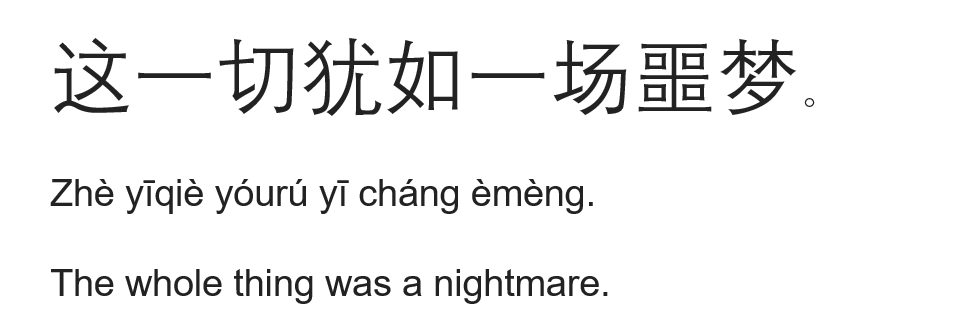
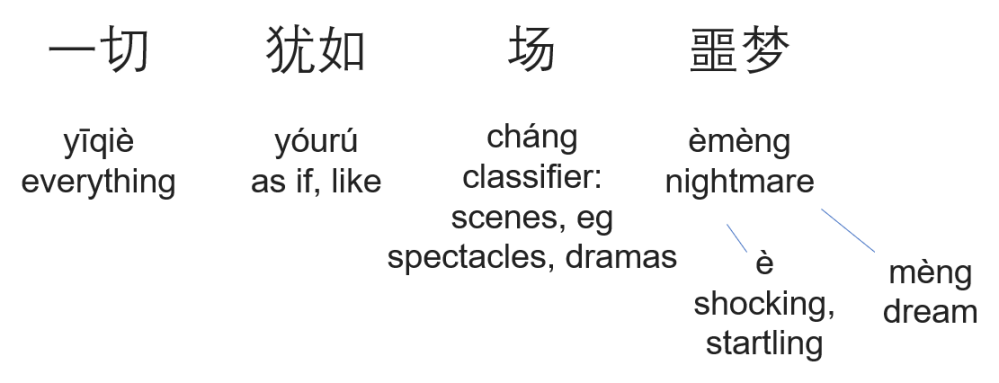
It’s interesting to note that 一切 means ‘all’, ‘everything’ or, in this case, ‘the whole thing’. We can see how 一 yī suggests wholeness, binding everything together as one. I am more used to seeing 切 qiè function as a verb – to cut or slice – but it can also be a mathematical noun – tangent or tangency. I had to look this up because it’s a long time since I learned about tangents at school. It means things which are in immediate physical contact with each other or are touching. From this I suppose it is only a small leap of imagination to envision how 一切 yīqiè means ‘everything’, ‘the whole thing’.
犹如 yóurú is a literary verb meaning ‘as if’. I think the purpose of 犹 yóu is to convert 如 rú into this specific verb form, ‘as if’, from other potential uses and meanings of 如 rú such as ‘like an arrow’ or ‘as you’ve said’ or forms of comparison such as ‘inferior to’ or ‘exceed’.
The word 噩梦 èmèng has this pleasing logic to it that illustrates why I like to break apart Chinese words and find out what they are composed of. In English, ‘nightmare’ does not have much of a direct relationship to the word ‘dream’. As it turns out, the etymology of nightmare is that it once referred to an evil spirit that visits people in their sleep. So for someone learning English as a second language, they would have to learn the words dream and nightmare separately. Chinese learners do not have this problem. You learn the character for dream and then bolt on a character to indicate what type of dream. This strikes me as rather satisfying, not to mention efficient.
Thanks to someone helpful on Reddit, I’ve just figured out why 场 cháng is in this sentence. It is a classifier, a measuring word. Chinese has a lot of these, the English equivalents are things like ‘a herd of cattle’ or ‘a bunch of flowers’. 场 cháng in the sense of ‘scene’ can be a classifier for performances, competitions, games, public spectacles, drama and film.
 The Hanyu You Want