Choosing a Chinese name is an elaborate business, as I discovered when I went down a rabbit hole of online advice and resources this evening. These are what I take to be some general rules:
- Choose one syllable to serve as your family name. Then you have an upper limit of two syllables for your given name, which will come afterwards.
- For your surname, be sure to choose one of the most common Chinese family names, this will help Chinese speakers understand that you are telling them your name and not attempting to say something else.
- Choosing a given name that conforms to traditional gender expectations helps people understand more readily when you are introducing yourself, which might not matter if you’re deliberately trying to be edgy but otherwise could be useful.
- Don’t phonetically translate your Western name, these sounds you are using have meanings, you will end up being called something ridiculous such as Isolation Sandwich or you could even end up sounding like some sort of criminal.
- If you give yourself a name that means something like ‘protect the nation’ then people will assume you had Revolution-era parents.
- Don’t borrow names that appear to you to be usable because you saw them being used by actors or characters in a film, or else you will go around calling yourself the Chinese equivalent of George Clooney or Gandalf, and that would not be good.
- Educated people in China choose names that allude to classical literature and poetry but this might be tricky for beginners, so just concentrate on not embarrassing yourself.
I spent ages thinking about what Gloria Startover’s Chinese name could be. I wanted S and G in there. I looked at the list of most common family names and after a lot of thought I picked out Sòng.
宋
After that I spent quite a long time with my dictionary and Google Translate, trying out possibilities for words that meant ‘new beginning’, ‘glorious’ and other meanings that I thought might allude to the purpose of the Gloria Startover project as an exercise of self-motivation, discipline and continual efforts of self-improvement.
Eventually I hit on guāng, meaning ray of light, which seemed quite appropriate, kind of inspiring.
光
I plugged 宋光 into Google to see if it is anyone’s name already and unfortunately Sòng Guāng is in fact the name of a Chinese politician who died within the last few years. I thought I had better not take it, I obviously know nothing about him, plus I wondered if 宋光 is going to sound like a very masculine name.
I tried out some more things. I looked up some words for different kinds of light and thought of bright daylight because I’m more clear-headed, productive and motivated in the light of day. Yángguāng means sunlight or sunshine.
阳光
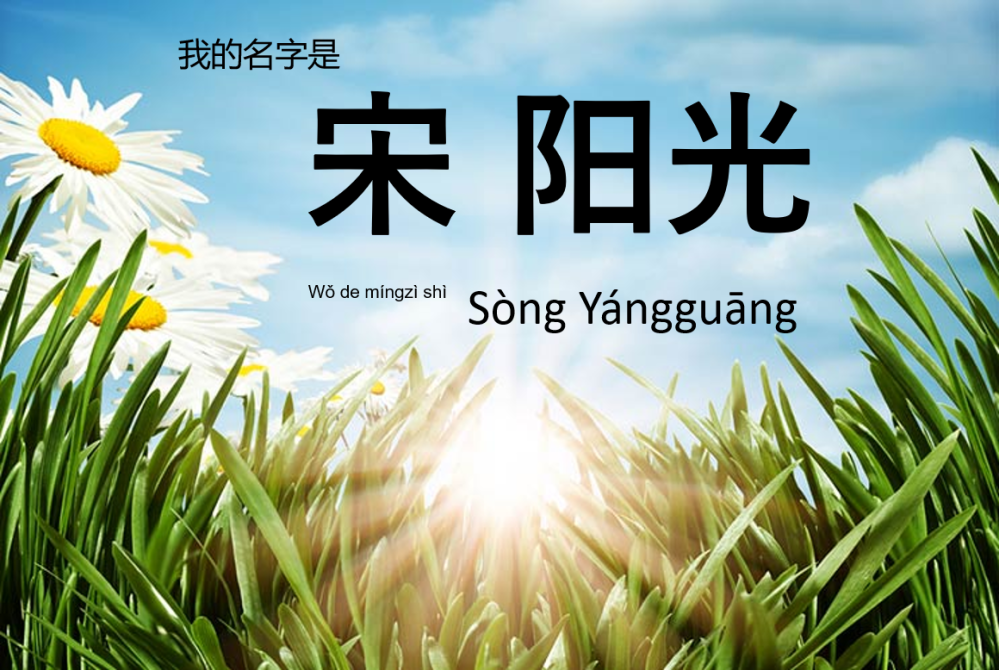
I Googled 宋 阳光 (Song, Sunshine) to see if it is anyone’s name and it seems that Sunshine is quite a popular name among young women, especially models with a social media presence, but I can’t identify that Sòng Yángguāng is the name of any huge celebrities, politicians or other public figures who might become a source of later embarrassment, so I’m just going to go with it until someone tells me why it’s a terrible idea.
 The Hanyu You Want